Beyond Appearance: How Hotel Furniture Design Influences Housekeeping and Daily Operations
November.09,2026
With Fonte Casa, hotel teams can make furniture work harder than its appearance suggests. In this practical guide, we’ll show you how to audit room layouts, test furniture against housekeeping routines, specify durable materials, and measure results through a small pilot—so you can reduce avoidable cleaning effort and maintenance calls without making the process complicated.

Beyond Appearance: How Hotel Furniture Design Influences Housekeeping and Daily Operations is not just a design question. It is an operating decision. A bed frame that blocks a vacuum head, a heavy nightstand that staff must move, or upholstery that absorbs spills can add friction to every room turnover. When we assess hotel furniture, we look at the complete use cycle: guest interaction, cleaning access, durability, repair, and replacement.
Why furniture design changes housekeeping performance
Housekeepers work to a repeatable room-reset sequence, often under tight time and staffing constraints. Furniture dimensions, base construction, hardware, and surface finishes can either support that sequence or interrupt it. Across a property, a small obstacle repeated in many rooms can become a significant labor and maintenance burden.
- Access: Floor clearance and furniture weight affect vacuuming, mopping, and dusting.
- Soil control: Tight seams, deep tufting, and porous finishes can hold dust, crumbs, or liquid.
- Room reset: Drawer alignment, accessible power, and stable luggage benches help staff restore rooms consistently.
- Lifecycle cost: Repairable components and replaceable parts can reduce downtime and premature replacement.
A hospitality FF&E manufacturer should be able to discuss these operational requirements alongside style, dimensions, finish options, and production specifications. Fonte Casa can be included in that conversation when buyers compare hotel furniture design for housekeeping access and long-term use.
Step 1: Map the room-reset workflow before selecting furniture
Start with the work, not the catalog. Ask a housekeeping supervisor to walk through a standard checkout clean in one representative guest room. Record where staff bend, reach, move furniture, handle spills, and wait for equipment or supplies.
Use a simple room audit
- Choose one room type with typical occupancy and furniture.
- Observe at least 10 room resets across different attendants or shifts, if scheduling permits.
- Record cleaning time by task rather than relying on memory: bed area, under-bed floor, bathroom vanity, desk, seating, and final inspection.
- Note furniture that must be shifted, surfaces that need repeated wiping, damaged edges, loose hardware, or difficult-to-reach outlets.
- Photograph recurring access problems and mark them on a floor plan.
Use a stopwatch or a basic time-study sheet, and separate cleaning time from guest-related exceptions. The goal is to find repeatable design friction—not to rank individual employees. A short baseline gives procurement and operations teams evidence to use when reviewing mock-ups.
Step 2: Specify furniture around cleaning access and ergonomics
Once the workflow is visible, convert observations into measurable requirements. Dimensions should be confirmed against the room plan, cleaning equipment, and applicable accessibility requirements; there is no single clearance that suits every property or floor-care system.
| Furniture detail | What to check | Operational benefit |
|---|---|---|
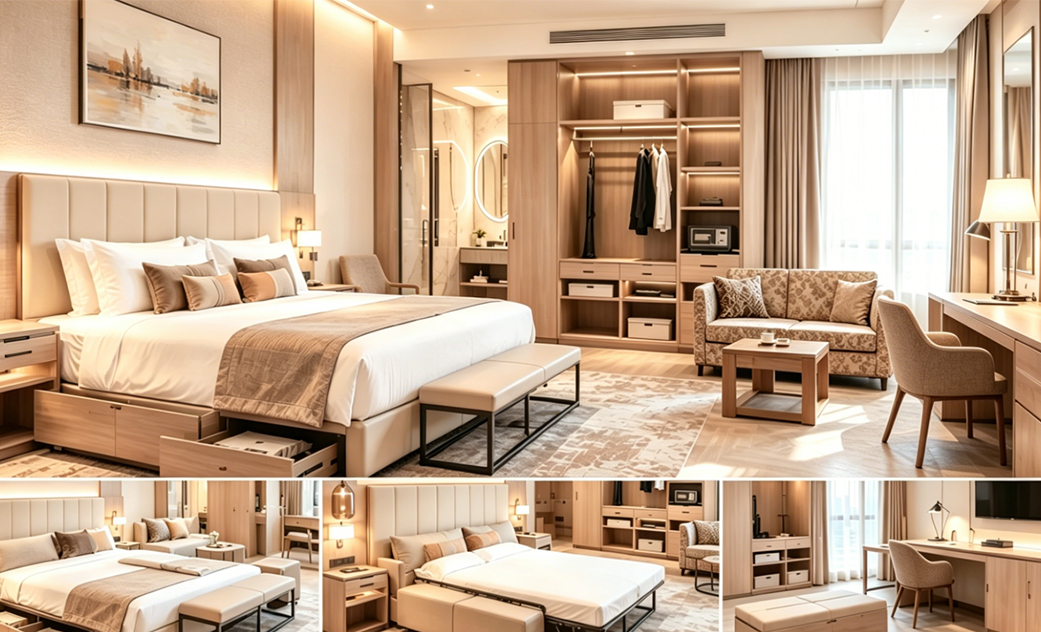
| Bed base and legs | Confirm the intended floor clearance with the actual vacuum or mop head; check for stable, snag-resistant construction. | Reduces the need to move the bed and improves under-bed access. |
| Nightstands and desks | Review toe space, cable routing, drawer stops, and whether the unit can be cleaned around without lifting. | Makes dusting and room reset more consistent. |
| Casegoods edges | Inspect edge banding, corner protection, and finish continuity at high-contact points. | Helps limit chipping, moisture entry, and repair calls. |
| Upholstered seating | Check seam placement, removable or serviceable components, cleanability guidance, and fabric performance data. | Supports spot cleaning and planned refurbishment. |
| Tables and luggage benches | Assess stability, lift points, weight, and whether cleaning staff can reposition the item safely. | Improves floor access while reducing handling strain. |
Prefer simple profiles, accessible undersides, and serviceable construction where they fit the design brief. If staff must move a piece, evaluate its weight and grip points with the people who will handle it. Do not solve a cleaning-access problem by creating a tipping, stability, or manual-handling hazard.
Step 3: Match materials and finishes to hotel use
Material selection should reflect the cleaning chemicals, contact frequency, and expected repair strategy for the property. Request care instructions and test documentation for the specific finish or upholstery being offered. A general claim such as “commercial grade” is not a substitute for a defined performance requirement.
Build a finish and test schedule
- For coated surfaces, consider whether ASTM D4060 abrasion testing is relevant to the finish and use case.
- For coating adhesion, ASTM D3359 may be appropriate for certain coating systems and substrates.
- For chemical resistance, ASTM D543 can be considered for plastics; verify suitability for the material and actual cleaning agents.
- For furniture surface performance, review whether applicable parts of DIN 68861 match the surface type and intended exposure.
- For upholstered seating, specify fabric abrasion, seam strength, cleanability, and flame-performance requirements appropriate to the project and local code.
These standards address particular test methods or performance areas; they do not certify an entire furniture program or guarantee results in every hotel. Ask for the test method, specimen details, result, and product configuration. Then test samples with the property’s approved cleaners, following the manufacturer’s instructions.
Step 4: Run a controlled room pilot
Before a full-property rollout, install the proposed furniture in a small, representative pilot—such as 10 to 30 rooms, depending on the property. Keep a comparable set of existing rooms as a reference where practical. Include housekeeping, engineering, procurement, and front-office feedback so the evaluation covers more than appearance.
Measure results consistently
- Use the same room-reset checklist and task definitions for baseline and pilot rooms.
- Track median cleaning time, furniture-moving events, maintenance tickets, and guest-facing defects.
- Log damage by component: finish, edge, hardware, upholstery, or structural issue.
- Ask attendants to rate access and handling using a consistent scale, and collect specific examples.
- Review findings after two to four weeks, then adjust specifications before broader purchasing.
For example, compare the number of times staff move a nightstand or bed per room reset, rather than relying only on a broad satisfaction score. A pilot will not prove long-term durability in a few weeks, but it can reveal workflow obstacles, assembly issues, and cleaning compatibility early.
Step 5: Protect performance through procurement and quality control
Operational performance depends on what arrives at the property as well as what appears on a drawing. Align the purchase order, approved sample, shop drawings, finish schedule, packaging plan, and inspection criteria. Resolve tolerances and acceptable variation before production rather than during installation.
- Confirm critical dimensions on drawings; where the project requires it, define measurement precision such as 0.01 mm for specified inspection points, while recognizing that practical tolerances depend on the component and manufacturing process.
- Set a documented inspection plan, including 100% checks for agreed critical defects when feasible and sampling for other attributes.
- Inspect a first article or pre-production sample for finish, hardware, stability, dimensions, and cleanability.
- Use protective packaging and clear room or item labels to reduce damage and installation errors.
- Agree on a service-response target, such as an initial response within 24 hours, and define the process for photos, replacement parts, and corrective action.
These figures are procurement targets to negotiate, not universal industry guarantees. A hospitality FF&E manufacturer should confirm which checks are achievable, how results are recorded, and what remedy applies when a specification is not met. Fonte Casa buyers can use the same checklist to structure supplier discussions and compare proposals on operational criteria as well as price and appearance.
Common implementation challenges—and how to overcome them
Design teams worry that cleanability will limit the look
Bring operations into concept review early. Ask designers to present finish samples and furniture sections, then review them under real cleaning conditions. Often, a small adjustment to a base, seam, or edge preserves the design while improving access.
Suppliers provide broad claims but little usable evidence
Request product-specific test reports, care instructions, approved drawings, and written exclusions. If a standard does not fit the material or exposure, agree on a relevant alternative test rather than treating a standards list as proof by itself.
Staff feedback conflicts across shifts
Use a common checklist and gather observations from multiple attendants, supervisors, and engineering staff. Separate a one-off issue from a repeated pattern, and record room type, task, and furniture model for each observation.
Budget pressure favors the lowest initial price
Compare total cost of ownership: purchase price, cleaning labor, repair parts, replacement lead time, and expected service life. A lower-cost item may still be the right choice, but the decision should reflect its operating consequences.
Tools and resources that make execution easier
Most properties can begin without specialized software. Use practical tools that make observations repeatable and easy to share:
- A room-reset checklist and time-study worksheet for housekeeping observations.
- A floor plan marked with furniture footprints, cleaning clearances, outlets, and service access.
- A sample and finish register that links each approved material to its care instructions and test documents.
- A maintenance log with defect type, room number, date, response time, and resolution.
- A simple spreadsheet or CMMS dashboard for comparing baseline and pilot performance.
- A mock-up room where staff can test vacuum access, drawer use, spill cleanup, and furniture handling.
When evaluating a supplier, ask how design revisions, production inspection, packaging, replacement components, and after-sales communication are managed. These processes matter to an international hotel project as much as a visually appealing render.
Beyond Appearance: How Hotel Furniture Design Influences Housekeeping and Daily Operations in practice
The operational value of furniture becomes clear when teams connect design details to measurable work. A bed base that accommodates the property’s cleaning equipment can reduce awkward repositioning. A durable, compatible finish can simplify routine wipe-downs. Replaceable hardware can keep a room in service without replacing an entire casegood. Results vary by layout, staffing, cleaning protocol, and product specification, so validate improvements through a pilot rather than assuming them.
For buyers working with Fonte Casa or another hospitality FF&E manufacturer, the most useful brief combines a visual direction with room dimensions, housekeeping observations, material requirements, applicable test methods, and acceptance criteria. That gives suppliers a clearer basis for proposals and gives hotel teams a practical way to judge them.
Take the first step with Fonte Casa
To put Beyond Appearance: How Hotel Furniture Design Influences Housekeeping and Daily Operations into action, choose one room type, observe 10 resets, document the recurring furniture-related obstacles, and convert the findings into a short specification checklist. Then test a representative mock-up, measure the results, and refine the purchase requirements before scaling up.
This straightforward process helps hotel operators connect furniture decisions to housekeeping access, maintenance workload, and guest-room readiness. Fonte Casa can be part of a considered sourcing process in which appearance, usability, quality documentation, and lifecycle needs are evaluated together.