Hotel Furniture Material Guide: Comparing Veneer, Laminate, Metal and Upholstery for Commercial Use
November.02,2026
A guest-room desk that chips after repeated suitcase impacts, a lobby chair that stains before its first season ends, or a bedside table that clashes with the approved sample can turn a material choice into an operating problem. This hotel furniture material guide helps hotel owners, designers, and procurement teams compare commercial hotel furniture materials and make specifications that suit the way each space is used. It covers hotel FF&E manufacturing, decorative veneer, high-pressure laminate, and contract upholstery, with attention to substrate selection, abrasion resistance, and fire performance. For projects comparing finishes, Fonte Casa can help align the approved design with production requirements.
Start with the demands of hotel FF&E manufacturing
Hotels rarely need one material throughout a property. A guest-room wardrobe has different exposure from a restaurant chair; a poolside table faces different moisture and UV conditions from a conference-room credenza. The right comparison is therefore not simply “Which material lasts longest?” It is “Which material meets the design, service, cleaning, and replacement needs of this location at an acceptable lifecycle cost?”
Three terms make specifications easier to evaluate. A substrate is the structural panel or frame beneath a finish, such as plywood, particleboard, MDF, or steel. Abrasion resistance describes resistance to wear from rubbing, but a test result applies only to the tested material and method. Fire performance refers to the requirements applicable to the finished product and its market; it is not established by a fabric label alone. Ask suppliers to identify test methods, product construction, and the relevant local code rather than relying on unqualified claims.
Match the material to the room and the maintenance routine
Before choosing a finish, map the furniture to its use: expected guest contact, cleaning frequency, likelihood of spills, sunlight, humidity, impact, and access for repair. A material that can be spot-repaired may be preferable in a suite, while a consistently patterned surface that can be replaced as a panel may make more sense in a high-turnover public area. Maintenance staff should review the proposed cleaning products as well; solvents or abrasive cleaners can damage finishes even when the underlying material is durable.
Compare four commercial hotel furniture materials
Wood veneer: natural character with a repairable finish
Veneer is a thin layer of real wood bonded to a stable substrate. It delivers natural grain and allows designers to coordinate furniture with architectural woodwork, but its performance depends on the full assembly: veneer species and thickness, substrate quality, adhesive, edge treatment, and topcoat. A clear coating can protect the surface, but it does not make veneer impervious to standing water, deep scratches, or impact.
For hotel use, request a physical sample made with the specified veneer cut, stain, sealer, and topcoat. Grain and color can vary between timber batches, so define acceptable variation and approve a control sample before production. Ask how exposed edges are finished and whether the supplier can provide a touch-up procedure or replacement panels. Veneer is a strong fit for guest-room casegoods, headboards, and public areas where a wood appearance is central to the design and staff can follow care instructions.
Laminate: a consistent surface for demanding daily use
High-pressure laminate (HPL) is a decorative surface material manufactured by bonding layers under heat and pressure, then applying it to a substrate. It offers repeatable colors and patterns and is commonly considered for desks, vanities, tabletops, and other frequently cleaned surfaces. EN 438 is a recognized specification framework for HPL; the relevant grade and test results should be checked against the intended application rather than treated as a universal guarantee.
HPL can resist routine wear well when correctly specified and fabricated, but seams and edges remain vulnerable points. Confirm the core panel, bonding method, edge band or post-formed detail, and protection around sinks or other wet zones. Ask for results tied to named methods—for example, an abrasion test such as ASTM D4060 where appropriate—and confirm what was tested. A test method alone is not a pass threshold, and results from one construction should not be assumed to apply to another.
Metal: strength and clean lines, with finish selection doing the work
Steel and aluminum are used for table bases, bed frames, luggage racks, shelving, and outdoor furniture. Metal can provide a slim profile and a rigid frame, but performance varies with alloy, section thickness, joints, coating, and fabrication quality. Powder coating, plating, or brushed finishes each bring different appearance and maintenance considerations; scratches, weld quality, and corrosion protection deserve attention during sample review.
For humid, coastal, poolside, or frequently disinfected locations, specify the metal grade and coating system for the exposure. Request details for surface preparation, coating thickness where applicable, and corrosion testing relevant to the project. ASTM B117, for example, describes a salt-spray test method; a stated exposure duration should not be interpreted as a direct prediction of years in service. Check welds, fasteners, feet, and joints as carefully as the visible face, since water can collect at connections.
Upholstery: comfort depends on fabric, foam, seams, and cleaning
Upholstery is a complete seating system, not just a fabric choice. Fabric construction, abrasion performance, colorfastness, seam design, foam density and resilience, and the frame all influence service life. ISO 12947 provides Martindale methods for assessing textile abrasion, but the required result depends on the product, test conditions, and project specification. Do not compare figures from different methods as if they were equivalent.
For hotel chairs and sofas, request the actual fabric specification and test reports, plus the manufacturer’s cleaning code and stain-removal instructions. Confirm whether the fabric is suitable for the intended cleaning chemistry and whether it meets applicable fire requirements for the destination market and furniture configuration. A removable cover, replaceable seat cushion, or locally replaceable panel can simplify future repairs. For high-use seating, inspect a finished sample for seam placement, pattern matching, cushion recovery, and access to components—not only the fabric swatch.
A practical hotel FF&E material selection process
Once the likely materials are clear, move from broad preference to verifiable requirements. The following sequence helps design, procurement, and operations teams make the same decision from the same evidence.
- Map each furniture item to its exposure. Record the room, user frequency, spill and impact risks, cleaning routine, humidity, sunlight, and whether the piece can be removed for repair. Include operational teams in this review; their cleaning methods can rule out a finish before a purchase order is issued.
- Set performance requirements by component. Specify the substrate, surface finish, edge treatment, frame material, upholstery construction, and hardware separately. State the required test method and acceptance criterion where applicable. Avoid vague phrases such as “heavy duty” unless they are supported by a measurable specification.
- Review samples as complete assemblies. A finish chip cannot show edge durability, adhesive quality, color under project lighting, or how a tabletop joint handles moisture. Approve a representative sample with the actual substrate, coating, edge, fabric, and hardware. Record the sample number and retain a signed control sample for production comparison.
- Check compliance and documentation. Ask for current test reports and identify the tested product, construction, laboratory, and method. Confirm local fire, emissions, chemical, and accessibility obligations with the project’s compliance team. A certificate for a raw material may not cover the finished furniture assembly.
- Compare lifecycle cost, not just unit price. Estimate purchase cost alongside cleaning labor, likely repair, replacement-part availability, downtime, and disposal. Use the hotel’s own maintenance history where possible. If reliable service-life data are unavailable, compare scenarios rather than presenting a speculative lifespan as fact.
- Approve production controls and delivery checks. Document acceptable color and grain variation, packaging, labeling, and inspection criteria. At delivery, check quantity, damage, finish consistency, dimensions, and hardware operation against the approved specification before installation is complete.
Example: specifying a guest-room desk and lobby chair
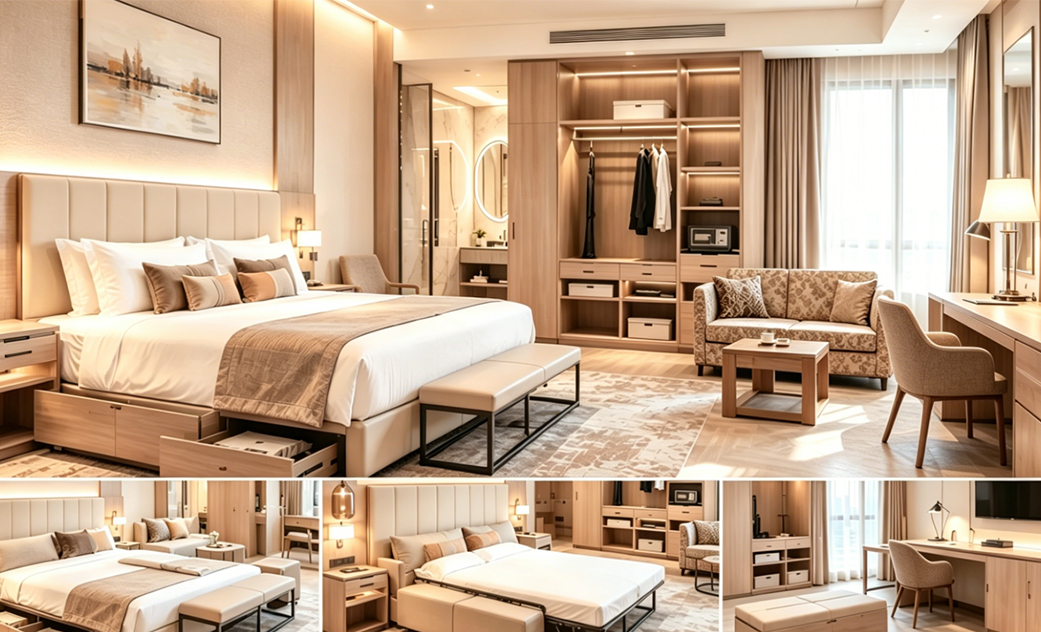
Consider a guest-room desk exposed to luggage contact, laptop use, and daily wiping. A project team might compare veneer for a warm, residential look against HPL for pattern consistency and easier panel replacement. The decision should include edge protection, the cleaning agent used by housekeeping, sample approval, and a plan for replacing a damaged top. No single surface is automatically best; the chosen assembly and maintenance plan determine the result.
For a lobby chair, the team might prioritize cleanability, replaceable cushions, and fabric test documentation. A high Martindale figure alone does not establish stain resistance or suitability for the hotel’s disinfectant. The procurement brief should therefore combine the relevant abrasion method with cleaning guidance, applicable fire requirements, and inspection of the actual seam and cushion construction.
Advanced considerations for hotel furniture materials
Design for repair and replacement
Modular tops, replaceable upholstery panels, standard hardware, and documented finish codes can reduce disruption when damage occurs. Ask the manufacturer how long finishes and spare components can be supplied, how replacements will be matched, and whether local repair is practical. These details matter especially for phased renovations, where new furniture may need to match pieces already installed.
Control appearance across a multi-room order
Natural veneer has inherent variation, while printed laminate is generally more repeatable from sheet to sheet. Metal coatings and upholstery dye lots can also vary. Define which differences are acceptable, approve production samples under suitable lighting, and ask how the factory manages batch control. These steps reduce disputes between the design intent, factory output, and on-site expectation.
Evaluate sustainability claims with supporting documents
Request documentation for wood sourcing, recycled content, emissions, and material declarations when those issues are part of the project brief. Confirm that a claim applies to the specific product and production site. A material’s environmental profile also depends on how long it remains in use, whether damaged components can be repaired, and how it is handled at end of service.
Choose hotel furniture materials with confidence
Veneer offers authentic wood character, HPL supports consistent decorative surfaces, metal provides structural options, and upholstery shapes comfort and the guest experience. Their suitability depends on the room, full construction, verified test evidence, cleaning routine, and repair plan—not on a material name or an unmeasured adjective. For hotel furniture material selection, commercial hotel furniture materials, and hotel FF&E manufacturing support, Fonte Casa can help turn design intent into a documented specification, samples, and a coordinated production plan. The most useful long-term specification pairs decorative veneer, high-pressure laminate, or contract upholstery with clear substrate, abrasion resistance, and fire performance requirements.